Research is in: Music during Surgery is a great idea!

Research is in:  Music during Surgery is a great idea!
Click on the picture to set up an appointment with Dr. Cash

Wednesday, August 06, 2008

Music Surgery Soundtrack to be released shortly!

I am sooo excited friends! I've put together the first in a series of downloadble soundtracks for surgery! This music will be available from a new page on my website and for those who are not adept at downloading music, I will also preprogram MP3 players for you to take directly into surgery. I'm working on the Ebook for Music and Surgery right now and putting the finishing touches on it. Please let all of your friends and families know about this exciting release. Surgery is an important and usually necessary event but it doesn't have to be as dangerous. Numerous studies document that patients listening to slow, steady, instrumental music through headphones (or earbuds!) need less anesthesia and anesthesia is one of the things people have to recover from!!
Please stay tuned!!

Sunday, July 20, 2008

More about the live music surgery research!

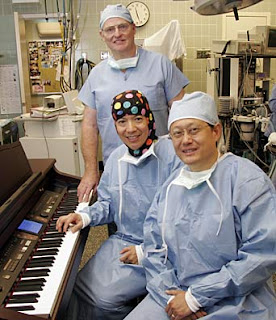
An eye surgeon in Hawaii has reported the results of a delightful study in which he played live classical piano music to some of his patients in the operating room before surgery. In the "preoperative holding area", patients' heart rates were measured along with their blood pressure and respiratory rate. Some of the patients then underwent conventional eye surgery, the noise of hospital machinery their only entertainment. Others were told that their surgeon would be playing them live piano music when they entered theatre, before they were sedated for their operation. Those in the non-music group showed an increase in heart rate and other signs of anxiety when they were in theatre. But the anxiety rates of those in the "musical surgeon"' group showed a beneficial decrease in the operating room. Any patient who has been in an operating theatre will know that it is no easy matter to feel less anxious there than in the waiting room, so this result seems inspiring. Recorded music is often played in operating theatres, but I had never heard of live music being played. "No complications occurred during or after surgery due to the presence of a piano in the OR", the study notes drily. The surgeon played relaxing, melodious music in a gently flowing tempo. Were the patients responding only to the music, or to the fact that their own surgeon was playing it? As the study speculates, "this may have added a further level of confidence in his surgical skill." I'm a classical pianist and, in the thoroughly non-medical setting of the concert hall, I've been struck by how often audience members confide that they have experienced some kind of beneficial effect on their wellbeing or state of health. All kinds of music can be beneficial, but I believe there is something about classical music which makes it specially effective, and I think its therapeutic effects could be more widely harnessed. The long spans of the music, the interplay of melody and harmony, the complex structure, the low volume levels, the absence of amplification, the subtlety of its rhythms – all these are conducive to a pleasurable meditative state at the very least. Moreover, the sight and sound of music being made near you, and for you, can be profoundly affecting. Having musicians and instruments in an operating theatre presents some tricky hygiene issues. Nevertheless my instinct tells me that live music must be more effective than recorded. I believe that the brain can distinguish between live and electronically reproduced music, and that live music is mysteriously more potent. If it reduces the need for sedation, and makes the patient feel calmer, it must be worth exploring the path outlined by the Hawaii experiment.

Tuesday, July 15, 2008

Calling Dr. Mozart!

The operating room of a hospital is a highly stressful place. Surgeons and assistants have to be extremely attentive, moving quickly but carefully. Playing music during surgeries has been shown to relax the staff and the patients. Some of the benefits that extend to the recovery room are lower heart rate, blood pressure and reduced need for pain medication.Dr. Claudius Conrad, now a senior surgical resident at Harvard Medical School, suggests music can go even further. He’s published a paper suggesting that music can stimulate a 50 percent jump in pituitary growth hormone. The hormone is associated with stress but, paradoxically, can help exert healing. Dr. Conrad is also a classically-trained pianist with a doctorate in music theory.Also, the study of music therapy has evolved in the United States for the past half a century, and there’s growing evidence that music is as good for the body as it is for the soul.

Thursday, June 26, 2008

Live piano music in surgery? Why not??

By Helen Altonnmailto:haltonn@starbulletin.com?subject=http://starbulletin.com/2008/06/25/Classical music played on a piano in the operating room for 115 patients having eye surgery at the former St. Francis Medical Center-Liliha had "profound" physical benefits, it was reported today. The music lowered the patients' blood pressure and heart and respiratory rates before any sedation or pain medication, according to a paper in the Medscape Journal of Medicine, a Web resource for physicians of peer-reviewed medical journal articles. Dr. Jorge Camara, a classically trained pianist and ophthalmologist, played music for patients before surgery as part of a study from May to August 2005 to demonstrate the medical benefits of music. The classical and semi-classical pieces ranged from Debussy's "Arabesque No. 1 in E Major" and Chopin's "Etude in E Major, Op. 10 No. 3," to "The More I See You," by Harry Warren and Mack Gordon. The patients, 49 to 79 years old, were having surgery for the first time. The study reports average decreases of 21 percent in their blood pressure, 8 percent in heart rate and 21 percent in breathing rate. "This sentinel paper validates the growing evidence that listening to relaxing music has profound beneficial effects on the physiologic functions of the human body," said Camara, director of ophthalmology in the Department of Surgery, University of Hawaii John A. Burns School of Medicine. He believes it's the first study in which a surgeon performed on a piano in an operating room for patients before surgery. When Camara began the project, Samuel Wong, former Honolulu Symphony music director, and Arthur Harvey, former University of Hawaii music professor and researcher, joined him in playing the piano for patients. A total of 203 patients underwent ophthalmologic procedures when the piano was in the operating room, but 88 had no music played. The result was "a statistically significant increase of their mean arterial blood pressure, heart rate and respiratory rate," the study found. Co-authors of the paper, "The Effects of Live Classical Piano Music on the Vital Signs of Patients Undergoing Ophthalmic Surgery," are Joseph Ruszkowski, Kamehameha Schools music teacher, and Dr. Sandra R. Worak, a research fellow trained by Camara now working in the Philippines. No complications were associated with the music, and patients "were very happy their doctor was playing the piano for them," Camara said in an interview. He said Kahala painter Laurie McKeon, 57, one of the patients who heard live music, wrote about the experience, explaining how scared she was to have surgery and how the piano music made a huge difference. She wrote: "The music soared above me, swirled around me. It penetrated through my pores, beyond my ears, past my mind and somehow, into my heart. I felt at peace. I felt safe. I felt like everything was going to be just fine. And it was." Camara no longer has live piano music in his operating room but patients hear a recording of him playing the piano. He is past president of the Aloha Medical Mission and has given three piano concerts to benefit the organization at the Neil Blaisdell Concert Hall. Citing growing interest in the medical benefits of music, he said, "So much more has to be studied," such as the effect on male versus female patients and rap music versus relaxing classical music. "This is only the beginning of a journey that will open our eyes to the wonderful potential of music for healing," he said. The paper can be seen on http://www.medscape.com/.

Saturday, June 21, 2008

Music and Surgery coming to Lexington!

Dr. Jay Zwischenberger, UK chief of surgery, plays his harmonica. Staff and patients are said to find "Dr. Z's" music a source of reassurance and comfort. June 13, 2008 Musicians have long known intuitively that experiencing the rhythms, harmonies and melodies of music —as listener or performer— can help mend the troubled mind, body and soul. And health professionals have long shared an intuitive understanding that this healing quality of music has a lot to offer medical science; witness the calming heart-rate monitors in a Savannah neo-natal ward as the regular visits of a harpist get underway. Now these enduring intuitions are converging to form the basis of an innovative program integrating the arts in health care at the new Chandler Medical Center at the University of Kentucky.

Monday, May 19, 2008

Seven Spiritual Ways to Prepare for Surgery

This article appeared in Positive Thinking and was written by Paul Sterman.
My wife, Joelle, was scheduled for surgery to remove her right adrenal gland in three months, and she was terrified. "Every night I'd wake up and my heart would be racing," she recalls. "Fear would come over me. And panic."It's a common reaction when facing a medical procedure. Some people are psychologically scarred by a past experience. Others fixate on the pain they might suffer, or like Joelle, on the helplessness of anesthesia. "I was afraid of not waking up or feeling really disoriented," she says. "It's that loss of control that's so scary."If you're a stressed-out patient like my wife was, there's hope. You can take steps to face down your fears. Joelle did, and they made a dramatic difference. Her strategies:Don't deny your fearSheila Messina, an R.N. who has had a dozen major surgeries, says it's helpful to recognize your anxiety and get your feelings out in the open. Stay connected with your friends and family. A new study published in the Journal of the American College of Surgeons shows that patients with a large support network feel less anxiety and pain prior to operations and have a quicker, smoother recovery.Ask questionsTalk to your physician and to other patients. Joelle peppered her doctor, Christopher Ng, M.D., of Cedars-Sinai Hospital in Los Angeles, with questions. His answers gave her a better idea of what to expect. Dr. Ng also put her in touch with patients who'd undergone the same operation. Talking to them "made me feel like I wasn't alone," Joelle says. "They survived—so could I."Meet your anesthesiologistMessina does this well ahead of an operation and is honest with the specialist about her fear, because it can affect her response to anesthesia. "We tend to become hypertensive when we are fearful, which can make recovery more complicated," she writes in her essay "Making Friends With Fear" in the journal Nutrition.Practice daily relaxation in the weeks leading upto surgeryJoelle used the techniques in psychotherapist Peggy Huddleston's book and CD, "Prepare for Surgery, Heal Faster." Huddleston recommends daily relaxation exercises such as deep breathing, meditation and guided imagery (picturing positive images in your mind, like a tranquil scene on a lake or the face of a person who makes you happy). Once you get the hang of these techniques, you can use them in the hospital to bring inner peace.Have a loved one keep you company before the operationWhat's the best thing friends and family can do? "Just stay there with them, hold their hand, have them take deep breaths," says Cathy Smith, an R.N. for Fairview Southdale Hospital in Minnesota. "They might need to cry a little or talk about their fears."Listen to music during pre-opResearch shows music reduces anxiety and blood pressure in hospital patients. It helps people focus on something other than their worries and the hospital noises around them, Smith notes. "Some even play music during their operation," she adds. "It brings them calmness and makes the heart rate slower, which is a good thing because it means less sedation may be needed." She says that ritual music, such as Tibetan chants, is particularly effective, but the important thing is to choose whatever makes you feel relaxed and uplifted. Joelle made a mix tape that included disco tunes, numbers from The Lion King and "slow songs we danced to at our wedding."Bring a little piece of home to the hospitalHuddleston suggests taking along photos and other belongings that help you feel comforted, relaxed and secure. Joelle brought a special blanket and a photograph from our honeymoon in Yosemite.All of the effort my wife put into learning what she could do to combat her fear about surgery paid off on the day of the operation. "I felt almost a calmness that morning," Joelle says. She came through the surgery with flying colors.

Sunday, May 11, 2008

Sufi Music in Surgery? Eyes wide shut??

(from the Turkish Daily News) Patients of the cardiac surgery intensive care unit at Memorial Hospital are treated with Sufi music therapy. The department’s medical specialist Erol Can, a Bulgarian immigrant of Turkish descent, tries to heal his patients through playing the ney, a traditional Sufi instrument. The tranquilizing sound of Sufi music echoes in the cardiac surgery intensive care unit of Istanbul's private Memorial Hospital where patients undergo Sufi music therapy as part of their treatment. Medical specialist Erol Can, who pioneered this treatment, was a member of the Turkish community in Bulgaria who were forced to migrate to Turkey in the 1980s. Upon his arrival, Can began researching the effects of the sound of the reed flute (ney) on the mental and physical health of his patients. Each day, while sitting next to one of his patients, Can played the ney and tried to see whether it had any effect on the patient's heart rhythm and blood pressure. After a series of experiments, he proved that Sufi music had positive effects on each patient's health condition. “We got negative results only for one patient,” said Can, noting that the patient was suffering from post-surgery depression at the time. This led Can to undertake further research, where he found that some parts of certain musical genres have negative effects on the individual. “Some parts are not suitable for patients who suffer from depression,” he said. He later decided to ask his patients which musical genre they prefer. Can had received a number of medals by Bulgarian authorities before the forced migration took place. He also hold a dozen of honorary diplomas, his name is on patented projects and he is the author of some 60 scientific articles so far. A cardiovascular specialist playing the ney Can is a graduate of the Medical University of Varna in Bulgaria. “I was not able to use my real name. The name that the Bulgarian state gave me was Emil Sariyef. And I just had to work two times harder than those genuine Bulgarians in order to be successful,” said Can. H managed to accomplish the impossible in the field of medicine and graduated with a perfect score of 100/100. “This was a kind of response to the discrimination imposed by the Bulgarian state,” he said. In 1989, when he was a PhD student, Can was subjected to forced migration from Bulgaria to Turkey. “Half of the members of my family were left behind. Moreover, I learned at the last moment that my mother had cancer,” he said. But Can also encountered problems upon his arrival in Turkey. “I was penniless. I had to start my life from the beginning. Furthermore, there was a huge cultural gap between me and the new social environment I was surrounded by,” he said, noting that at that point he began using music as a remedy for himself. This is not surprising as Can was born into a musician family and has always been drawn to music ever since his early childhood years during which he learned to play many musical instruments. The Florance Nightingale Hospital in Istanbul was the first institution in Turkey where Can began to practice medicine. He then continued his career at the cardiac surgery intensive care unit of Memorial Hospital. This was where he performed his initial music therapies with the ney. “Once I played the ney for an unconscious patient of mine. When he regained consciousness I asked him how he felt and he told me he had found himself listening to peaceful music in heaven,” said Can. Music therapy an Eastern tradition Can said music has always been a significant part of rituals and ceremonies at special instances like births and deaths throughout history, since the early Pagan times. For him, its positive effects on the human soul cannot be denied. He said he borrowed the music therapy method from the Orient. “In the Medieval times, while some patients used to be burned in the West because they used to be perceived as souls possessed by evil, experts in the East were treating their patients with music and water therapies,” he said. Specifically, the sound produced by the ney and the kemençe (the Eastern equivalent of the fiddle) is the closest to the human voice and therefore gives the human soul a feeling of peace and serenity, he added. Not so long ago, Can himself underwent heart bypass surgery. As he was preparing for the operation, he wanted to hear the sound of the ney. “My blood pressure had jumped to 160 for I was quite nervous before I listened to the ney sound. But after I listened to it, I took my blood pressure again and it was 130,” he said, referring to his personal experience of ney therapy. A mere hours after he awoke, Can began playing the ney as though he had just taken some painkillers.